2026xi1, Sunday: All good things.

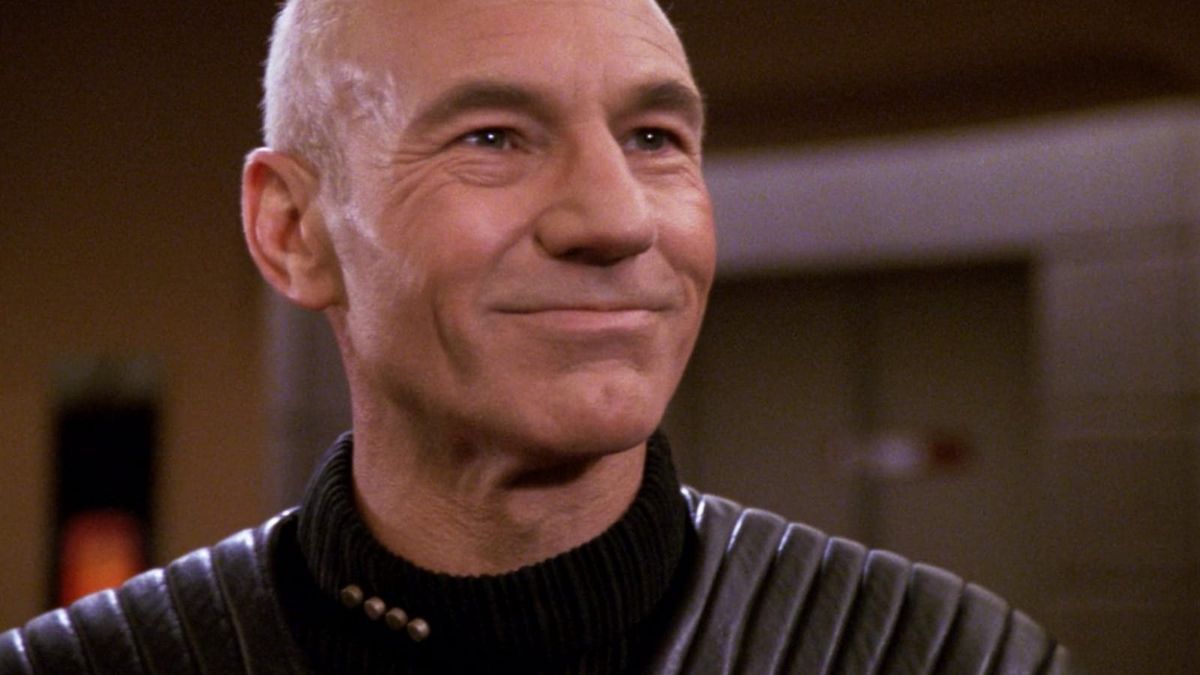
He was never my captain. His Trek was never my Trek.
Those honours go elsewhere.*
So the loss I'm feeling at the death of Patrick Stewart is surprising me just a little bit. There's a hole in the world I wasn't ready for.
It's not that I ever had a problem with Star Trek: The Next Generation. It's just that when it was first out I found it a bit - well - blah.
It's possible that I was exposed - in its initial run, back in the bad old VHS days before TiVo and streaming and all - to too many of the episodes that were frankly bad. Too much season 1. Not enough of the later shows (seasons 3 and 6: looking at you). And as I later realised, I was never much of a one for purely episodic television: so when Babylon 5 arrived, with its creaky sets and sometimes wooden guest stars but its involved, in-depth, narratives playing out and paying off over a full half-decade, it was like water slaking a thirst I didn't know I had.
So back in the day, TNG wasn't for me.
Still, the older I've got, the more I've come to appreciate it. To love it. To see that it's essential. Not only for the fact it got much, much better as the years passed; but far more for the hope it stood for.
And Patrick Stewart's Picard exemplified that hope, that faith. A faith that thoughtfulness, kindness, an outstretched hand rather than a mailed fist, could prevail. That it really was better to seek to understand than to dominate. That success came not from taking the pie, but sharing it.
That true leadership was more about love - and yes, Jean-Luc was full of love in how he dealt with others, even if he'd never have been able to bring himself to say so - than it was about strength.
I've seen countless remembrances, obituaries, expressions of loss. Far too many. And the common thread is just that: a vision not so much of an imaginary future, but of a possible one; of a humanity worth striving for.
Each Starfleet captain is a story that we tell ourselves about what leadership should look like. At times Star Trek, as an overall franchise, has unfortunately reflected any and all bigotries that exist in the world. But through it all, Stewart, as Picard, projected an image of masculinity that was …well, it was usually kind of wonderful. Picard wasn’t a violent, angry, manipulative or deceptive man. He listened to everyone — really listened — regardless of their rank, gender, race, or where they came from. His relationship with a strong, intelligent woman – Beverly Crusher – was one of the best parts of TNG. But beyond her, in general, people followed Picard all over the galaxy and into battle because he led and made decisions with intelligence and compassion — and both parts of that formula mattered.
Intelligence. Compassion. Listening. Or as one of the best iterations of another genre icon put it in his final moments in the character:
Always try to be nice. But never fail to be kind.
Stewart himself was no saint. But by all accounts he was a good man, as men go; which is the most any of us could ask of anyone. I'd never hitherto seen another clip linked to in one of the remembrances, of him taking a Q&A at a US con. But it told a story of someone for whom it was natural to reach out - with true and innate kindness - to a fan who with complete justification needed a word, and a hug, and to be seen. Warmth, understanding, trying to see the heart of things. Embracing, not rejecting.**
So yes. Today, yesterday, the day before and before, something's a wee bit broken. I'm still sad at the loss of a man who helped us see that the future could be kind, and thoughtful, and generous, and open - and still may be, if we so choose.
And there's his epitaph, his legacy. If we act as though the Federation - the best of the Federation, mark you*** - exists, then perhaps it can.
All good things don't have to come to an end. That only happens if we lose faith in them.**** Let's not.
*Benjamin Lafayette Sisko. DS9. Always.
**There's a moment in this clip, which explains succinctly and superbly part of what being a real man is all about - and what it's not - where he mentions his mother, in connection with doing her honour by his support for the vital campaign against violence done to women and girls, particularly in a domestic context. His normal, drama school-trained accent dominates throughout; but then, for a split second, as he says "in my mother's name", it slips, and the Yorkshire creeps through. It's barely noticeable. But it's there. And it's beautiful.
***And yes, I recognise that DS9's grey areas included some of the more unpleasant underbellies of the Federation - which is what some dedicated lovers of TNG may see as a bit of a betrayal of what I've described above. But I see it differently. There's no such thing as perfection. There's always the bad side. Pretending it's not there is what allows it to fester, and gives it strength; whereas seeing it, and confronting it, is what allows the good to flourish. Because we're broken. And we make mistakes. And still we can, somehow, try to shine. If ever there was a credo that Jean-Luc - and I think Sir Patrick as well - would have stood for, perhaps it's that.
****Because - as a pivotal character from another favourite franchise once put it, memorably and rightly - faith manages.


